01
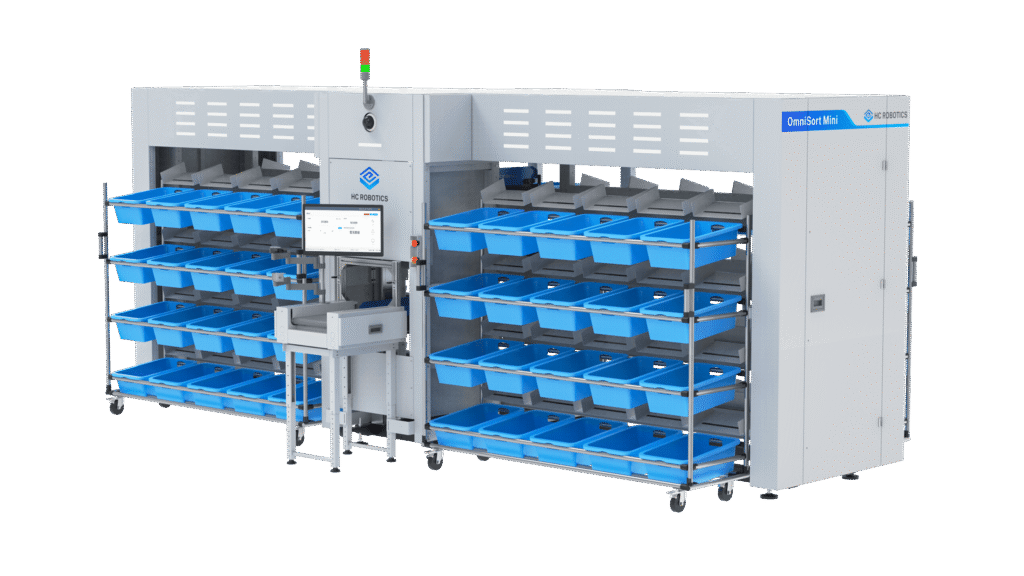
Compact sortation
For a defined sorting area with a smaller destination count. Review induction ergonomics, collection access and how operators clear completed orders.

Warehouse Automation · Parcel Sortation
Robot-based parcel sorting for e-commerce, 3PL and distribution centres, supplied with a local team for product questions and after-sales support.

What we supply
TTF TECH supplies automated sortation systems in which sorting robots, induction stations and barcode and weight scanning identify each parcel and deliver it to the right destination. Choose a compact unit for smaller operations or a full-size system that grows by adding robots and destinations.
Challenges
Manual sorting slows down as order volume grows and depends on people reading labels correctly. A robot-based sortation system scans every parcel and routes it automatically, so sorting keeps pace with volume without adding the same number of sorters.
A full-size system sorts 1,500 or more pieces per hour.
Each parcel is checked by barcode and weight before it is routed.
Operators work at induction; robots do the walking.
The compact model fits in about 5.6 m × 2.6 m.
The modular layout can be reconfigured and extended.
TTF TECH is your point of contact in Malaysia for product and after-sales questions.
Options
Automated sortation identifies each item and directs it to a defined destination. The right configuration depends on your item mix, peak volume, available space and dispatch process.
01
For a defined sorting area with a smaller destination count. Review induction ergonomics, collection access and how operators clear completed orders.
02
For projects with more destinations or higher peak demand. The layout, robot count, scan arrangement and collection method should follow the required operating flow.
Capabilities
Specifications
| Parameter | Compact model | Full-size system |
|---|---|---|
| Sorting rate | 800+ pieces per hour | 1,500+ pieces per hour |
| Number of robots | 3 or 4 | 10 or more |
| Destinations | 60 or 80 | Configured per project |
| Destination type | Cart | Tote, cart or flow rack |
| Footprint | 5.6 m × 2.6 m × 2.1 m | Length 4 – 30 m, height configurable |
| Maximum parcel weight | 5 kg | 5 kg (small and medium robots), 8 kg (large robot) |
| Scanning | On request | Top or five-sided |
| Robot navigation | QR code | On request |
| Communication | Wired | Wi-Fi and RF |
| Charging | Wired | Contact rail and supercapacitor |
| Robot speed | On request | 4 m/s |
Comparison
Manual sorting relies on people reading labels and walking parcels to the right cage. An automated sortation system scans each parcel and lets robots deliver it, which makes accuracy and throughput far less dependent on headcount.
| Factor | Manual sorting | Automated sortation system |
|---|---|---|
| How parcels are identified | Staff read the label | Barcode scan with weight check |
| How parcels reach the destination | Staff carry or push them | Sorting robots deliver them |
| Handling a volume peak | Add people or shifts | Add robots or destinations |
| Changing destinations | Re-arrange the floor and re-brief staff | Reconfigure the modular layout |
| Sorting record | Manual tally | Logged per parcel |
How it works
An operator or conveyor places each parcel on a sorting robot.
The system reads the barcode and checks the weight.
The control software assigns a destination and a path.
The robot travels to the destination and tips the parcel in.
The robot returns to induction for the next parcel and recharges on the system.
Layout, number of robots and software connection are specified per project with the equipment supplier.
In operation
Requirements
| Selection factor | What to define |
|---|---|
| Items | Minimum and maximum dimensions, weight, packaging and barcode position |
| Demand | Average and peak items per hour, operating hours and growth allowance |
| Destinations | Number of orders, lanes or routes open at the same time |
| Operations | Induction, exception handling, completed-order removal and dispatch |
Local support
TTF TECH helps customers and project partners evaluate equipment suitability, supplier options and local service arrangements. Controls, software interfaces and installation responsibilities are agreed for each project.
FAQ
Parcels and order items up to 5 kg on small and medium robots, and up to 8 kg on the large robot.
The compact model sorts 800 or more pieces per hour. The full-size system sorts 1,500 or more pieces per hour.
The compact model measures about 5.6 m × 2.6 m × 2.1 m. The full-size system is configured from 4 m to 30 m long.
E-commerce and retail, manufacturing and distribution, third-party logistics, cold chain, electronics and pharmaceuticals.
Confirm the item range, packaging, peak flow, destination count, available space and handling limits. Include induction, identification, exception handling and downstream capacity.
Define an exception route for unreadable labels, unknown destinations or unsuitable items. The selected equipment and software must support the agreed handling and recovery process.
Yes. TTF TECH is based in Malaysia and is your local point of contact for product enquiries and after-sales support. The service scope is agreed for each project.
Let's plan your next step
Share item sizes and weights, peak volumes, destination count, identification method and dispatch layout.
Related products