
AMR vs AGV:
What's the Difference and Which Fits Your Warehouse?
Walk onto any modern warehouse floor today and you’ll likely spot a robot gliding between racks, moving pallets, or navigating around a corner without a human in sight. But not all warehouse robots work the same way — and choosing the wrong type can mean costly rework down the line. Two terms come up constantly in this conversation: AMR (Autonomous Mobile Robot) and AGV (Automated Guided Vehicle). They sound similar, but the way they think, move, and adapt couldn’t be more different.
For Malaysian manufacturers and 3PL providers weighing automation investments, understanding this difference isn’t just technical trivia — it directly affects installation cost, flexibility, and how quickly your warehouse can scale.
What is an AGV (Automated Guided Vehicle)?
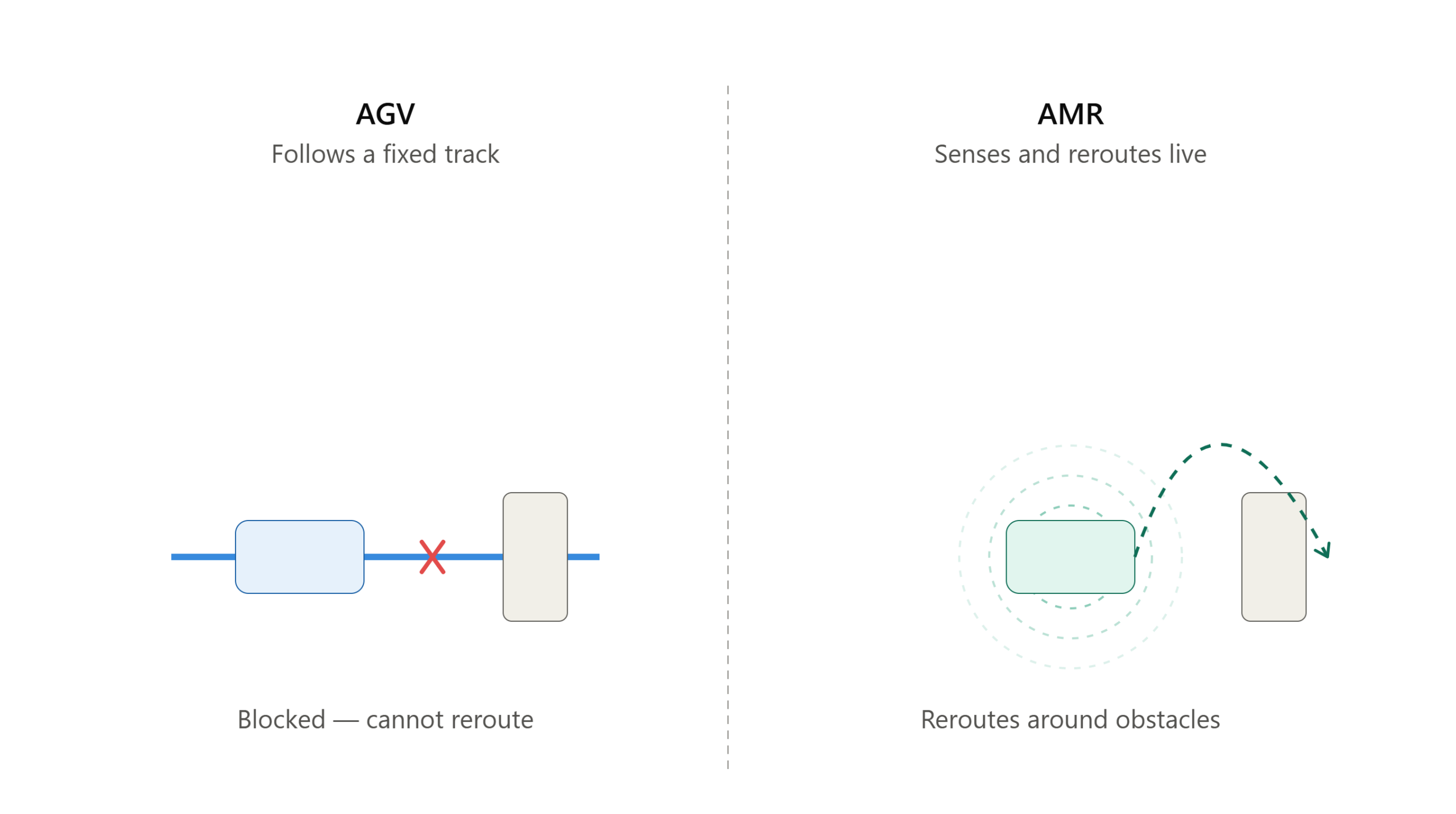
An AGV is the older, more established technology in warehouse automation. It moves along a fixed, predetermined path — typically guided by physical infrastructure such as magnetic tape on the floor, embedded wires, or reflective markers read by sensors. Think of it as a train on a track: reliable and consistent, but locked into one route.
AGVs excel in environments where the workflow rarely changes — repetitive point-A-to-point-B transport, such as moving raw materials from receiving to a fixed production line.
Key characteristics of AGVs:
- Requires physical infrastructure installation (tape, wires, or markers)
- Follows fixed routes — cannot dynamically reroute
- Lower per-unit cost for simple, unchanging workflows
- Rerouting requires physical reinstallation of guidance infrastructure
What is an AMR (Autonomous Mobile Robot)?
An AMR represents the newer generation of warehouse robotics. Instead of following a physical track, it uses onboard sensors, cameras, and SLAM (Simultaneous Localization and Mapping) technology to understand its environment in real time. It builds a live map of the warehouse, detects obstacles, and dynamically re-calculates its path — much like how a smartphone GPS reroutes you around traffic.
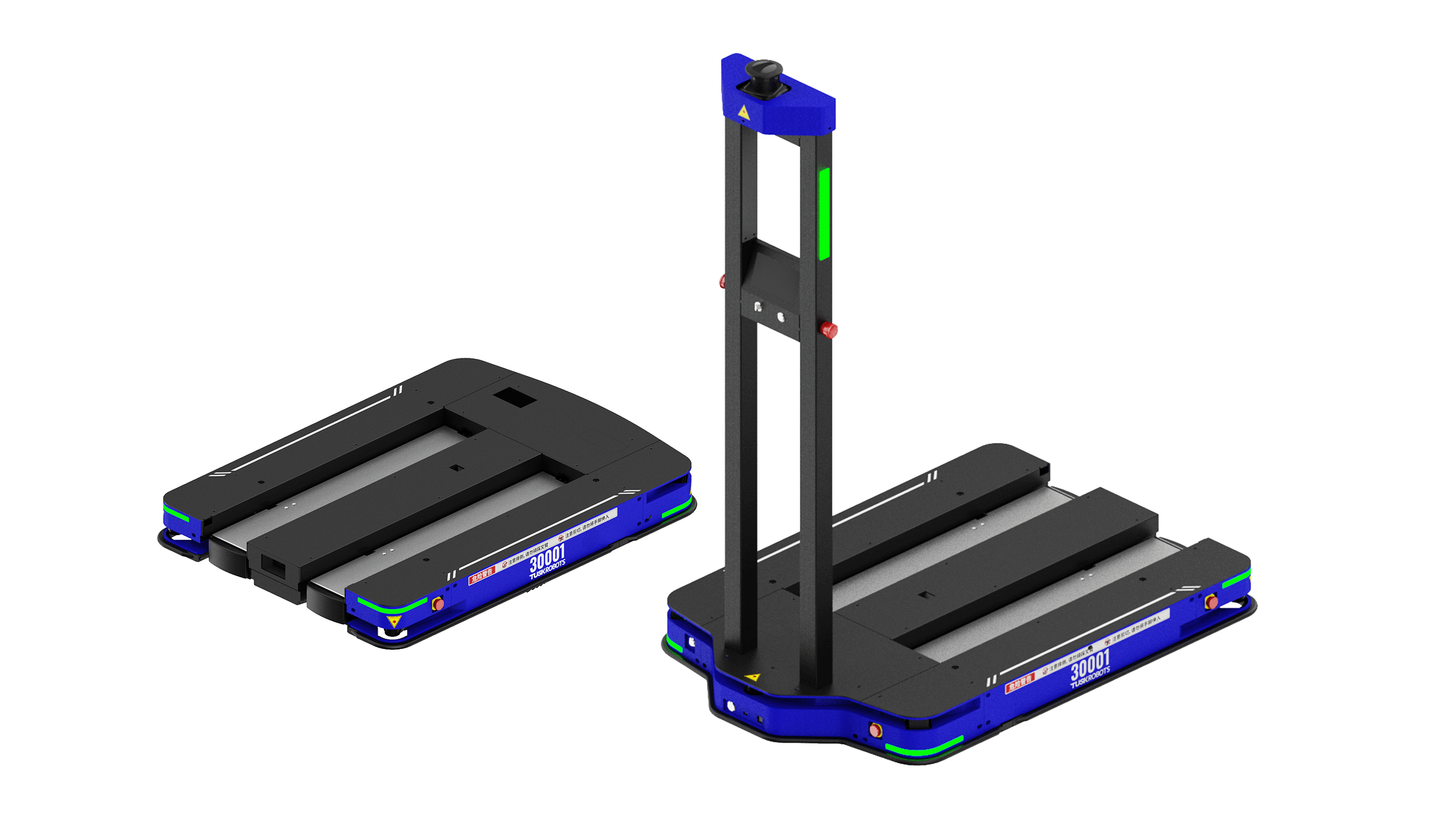
This is the technology behind solutions like TUSKROBOTS AMR, which is designed to navigate shared spaces with people, forklifts, and shifting layouts without requiring any fixed infrastructure.
Key characteristics of AMRs:
- No physical infrastructure required — deploys faster
- Dynamically reroutes around obstacles and people in real time
- Easily scales or adjusts as warehouse layout changes
- Higher upfront intelligence, but significantly more flexible long-term
AMR vs AGV: Side-by-Side Comparison
| Factor | AGV | AMR |
|---|---|---|
|
Navigation |
Fixed path (tape/wire/markers) |
Dynamic, sensor-based (SLAM) |
|
Infrastructure needed |
Yes — physical installation |
None |
|
Flexibility |
Low — fixed routes only |
High — adapts to layout changes |
|
Obstacle handling |
Stops or requires clear path |
Detects and reroutes automatically |
|
Deployment speed |
Slower (requires infrastructure setup) |
Faster (map-and-go) |
|
Best for |
Stable, repetitive workflows |
Dynamic, shared, or growing warehouses |
Which One Fits Your Warehouse?
The right choice depends less on which technology is “better” and more on how often your warehouse layout and workflow change.
Choose an AGV if:
- Your production line layout is stable and unlikely to change
- You have a fixed, predictable transport route
- Budget for initial setup is tighter than long-term flexibility needs
Choose an AMR if:
- Your warehouse operates alongside human workers and forklifts
- You anticipate layout changes, seasonal reconfiguration, or business growth
- You want to avoid the cost and downtime of reinstalling guidance infrastructure every time your floor plan shifts
For most growing Malaysian manufacturers and 3PL operators — especially those dealing with e-commerce peak seasons or multi-client 3PL operations — the flexibility of an AMR often outweighs the marginally lower upfront cost of an AGV.
Still deciding between AGV and AMR for your operations? Explore TUSKROBOTS Autonomous Mobile Robot to see how flexible, infrastructure-free automation could fit your warehouse — or get in touch with our team for a tailored recommendation.
Our Solutions
Contact Us
Frequently Asked Questions
Is an AMR more expensive than an AGV?
AMRs typically have a higher initial unit cost due to onboard sensors and computing power. However, since they don’t require physical infrastructure installation, total deployment cost is often comparable — and AMRs avoid the recurring cost of reinstalling guidance systems when layouts change.
Can AGVs and AMRs work in the same warehouse?
Yes. Some facilities use a hybrid approach — AGVs for fixed, high-volume repetitive routes, and AMRs for more dynamic zones that require flexibility around changing layouts or shared human workspaces.
How long does it take to deploy an AMR compared to an AGV?
AGV deployment typically takes longer due to the need to install and calibrate physical guidance infrastructure. AMRs can often be mapped and operational within a much shorter timeframe since they rely on software-based navigation rather than physical installation.
Do AMRs require internet connectivity to function?
Most AMRs, including TUSKROBOTS, operate using onboard processing for navigation and do not require constant internet connectivity to move safely — though connectivity is often used for fleet management and reporting via the Warehouse Control System (WCS).